
It always starts innocently.
Your baby did a thing. Or didn't do a thing. And now it's 2am, the house is finally quiet, and you're seventeen tabs deep into a search that began with "when do babies roll over" and has somehow ended on a message board from 2011, a milestone app that's actively stressing you out, and a heart rate that says DANGER even though the baby in question is asleep and thriving four feet away.

First things first: put the phone down. Second: you're not doing anything wrong. "Is this normal?" might be the most human question a parent can ask, and I hear some version of it almost every single week — usually a little panicked, often whispered, almost always followed by "…or am I overthinking it?"
If you've typed "is my baby developing normally" into a search bar at an ungodly hour, this one's for you. Let me tell you the thing I wish the internet led with.
Baby development is a range, not a checklist
Somewhere along the way, milestones got turned into a scoreboard. Apps ping you. Charts rank you. Someone's cousin's baby did the thing three weeks "early" and now it's a whole personality. But real development doesn't run on a spreadsheet. Kids hit milestones on wildly different timelines. They skip things and circle back. They pour every ounce of energy into one skill while another sits quietly on the back burner, waiting its turn.
"Normal" is a much bigger, weirder, more forgiving umbrella than a chart makes it look. Most of the time, the honest answer to "is this normal?" is a warm, boring, wonderful yes.
Why "is this normal?" feels so scary at 2am
Because we're comparing. Because the algorithm feeds you the one baby doing the impressive party trick, not the eleven who are perfectly on track and currently eating a sock. Because nobody hands you a rulebook when you leave the hospital, so you end up building one out of Google results at midnight.
That's not anxiety for no reason. That's love with nowhere to put itself. And I'd much rather you put it somewhere useful than lie awake ranking your kid against a stranger's.

When a baby milestone is actually worth a closer look
Here's the part I actually want you to hear, because "everything's a range" can quietly tip into "so I should ignore everything," and that's not it either.
Sometimes there's a small pattern worth a conversation. Not an emergency — a pattern. A few examples of the kind of thing I'd want to peek at:
A baby who strongly and consistently prefers turning their head one direction — always looking left, always sleeping with their face the same way.
A tummy-time strike that feels like more than plain stubbornness — real, repeated distress rather than the standard "I have opinions about the floor."
A little one who seems tight or uncomfortable in ways that don't settle with the usual snuggle-feed-change lineup.
Feeding that's a constant battle — trouble latching on one side, fussiness that lines up with certain positions.
None of these mean something is wrong. They just mean it might be worth having someone take a look who watches tiny bodies move all day.
What a family chiropractor actually does (and what I don't)
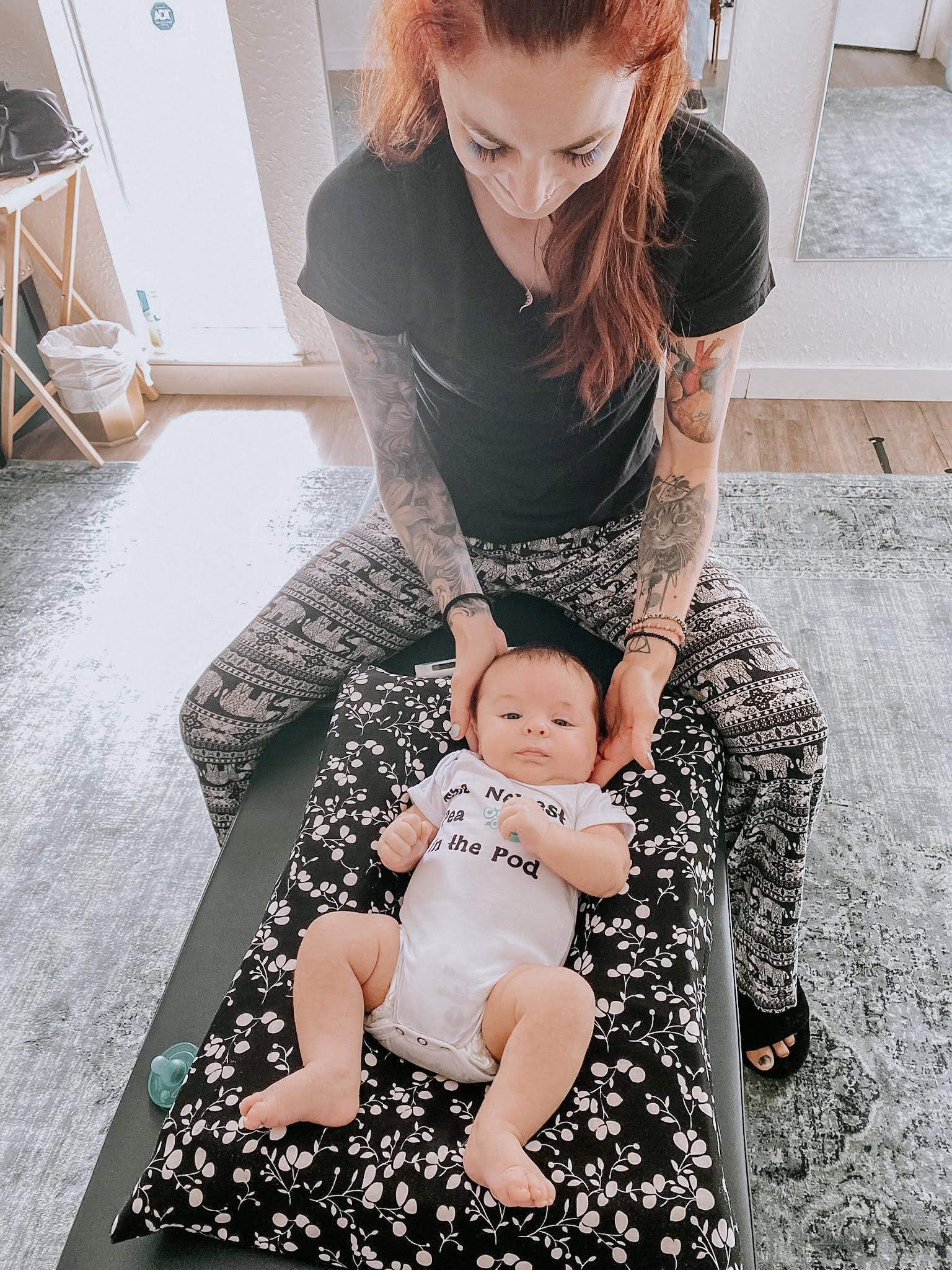
I'm not here to diagnose your baby or move milestones around on a timeline. What I do is watch how your baby is using their body — how they move, where they're holding tension, whether their posture and positioning are helping them reach for the next thing or quietly getting in the way.
Sometimes that's a couple of tummy-time tweaks and a "keep me posted." Sometimes it's gentle, appropriate work in the office. And sometimes — genuinely, often — it's me watching your kid for a few minutes and saying, "this looks great, go enjoy your baby."
And always, always, alongside your pediatrician — never instead of them. Your pediatrician is watching the big picture of your child's health, and I'm one more set of eyes on how they're moving. Different jobs, same team, both in your corner.
The new part: you can now just ask me
I know "should I book a whole appointment for one question?" is its own little barrier. It feels like a lot for a "hey, quick thing." So I've added something I'm genuinely excited about: online virtual consults.
It's a one-on-one video visit where we actually talk it through. You tell me what you're seeing, I help you sort it into one of three buckets — keep an eye on it,let's take a closer look in person, or breathe, this is textbook — and you walk away with a plan instead of seventeen tabs.
A couple of honest notes so there are no surprises:
It's fact-finding, not a diagnosis.
I can only consult with folks here in Texas — it's the only state I'm licensed in.
A screen can't replace being seen in person. Some things I just have to feel with my hands, and I'll tell you when that's the case.
Consults are $99, and if we decide together that in-person care is the right next step, that $99 comes straight off your new patient visit.
The takeaway
You know your kid better than any chart does. Trust that. Ask the questions — the "silly" ones especially. And the next time you catch yourself spiraling at 2am, close the tabs, put the phone face-down, and bring the question to someone who would genuinely rather answer it than have you lose sleep over it.
That someone is me. Let's talk.
