
Your Body Is Stressed. It's Not Being Dramatic.
I have this conversation almost every single day in the office. Someone comes in, rattles off a list of things going on with them or their kid, and then says something like "I don't know, maybe I'm overthinking it." And I have to stop them because no, actually, your body is not overthinking it. Your body is doing exactly what it's supposed to do. It's adapting. The question is just: what is it adapting to?
Your nervous system is running 24/7 whether you acknowledge it or not. It controls everything. Your breathing, your digestion, your immune response, how your kid's brain develops, how well you sleep, why your shoulders are basically earrings at this point. When it's working well, you don't even notice it. When it's overloaded, you notice it in a hundred different ways that seem totally unrelated but usually aren't.
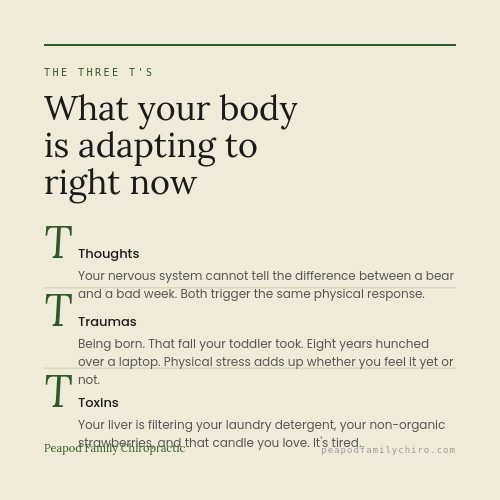
In chiropractic, we talk about three main categories of things that stress your nervous system. We call them the Three T's: Thoughts, Traumas, and Toxins. I know, very creative. But stick with me because once you get this, a lot of stuff starts clicking.
Thoughts (yes, your feelings are doing something physical to you)
I know "stress affects your body" sounds like something on a motivational poster, but I want to be specific about what's actually happening because it's kind of wild. When you're anxious, grieving, running on fumes, or just low-key freaking out about your bank account, your body responds the same way it would if a bear walked into the room. Cortisol spikes. Your muscles tighten up. Digestion slows to a crawl because your body doesn't care about digesting lunch when it thinks you're being chased. Your immune system takes a back seat.
That response is great if there's an actual bear. It is less great when the "bear" is your inbox, your toddler's sleep regression, and the fact that you forgot to defrost something for dinner. Again.
When that stress state becomes your baseline, your nervous system gets stuck in it. And a nervous system stuck in fight-or-flight isn't healing, isn't regulating, and isn't doing its best work. This is also why I don't just ask about your physical stuff when you come in. How are you sleeping? How's your stress? Because you cannot separate those things from what's happening in your body.
Traumas (and no, you don't have to have been in a car accident)
Most people hear "trauma" and think major injury. And sure, those count. But so does being born. So does the C-section your baby came out of, or the vacuum that helped them along. So does the fall your three-year-old took off the couch last week that you're pretty sure was fine but also you're not totally sure. So does sitting at a desk for eight hours hunched over a laptop, or babywearing on the same hip for two years straight because your kid refuses the other side.
Physical stress accumulates. It doesn't matter how big or small it is. When the spine gets tweaked and stays tweaked, it affects how the nervous system communicates with the rest of the body. Not just in a "your back hurts" way. In a "your kid can't latch, has colic, is constipated, won't sleep, is hitting meltdowns constantly" kind of way. Tension in the nervous system shows up differently in every person, which is why two kids with the same birth history can present completely differently.
This is what adjustments are actually for. Not cracking backs for fun (although, honestly, satisfying). Restoring communication in the nervous system so the body can do what it's already trying to do.
Toxins (your liver is tired and it would like you to know)
Your body filters stuff constantly. Your liver, your kidneys, your lymphatic system, your gut are all working together to process and clear out what you don't need. That includes the pesticides on your non-organic strawberries, the fragrance in your laundry detergent, the pollution you drove through this morning, and yes, the ingredients in products you're probably using on your kid right now without realizing it.
Nobody can avoid all of it. I'm not going to tell you to throw out everything in your house and go live in a yurt. But there's a real difference between a body that has a manageable toxic load and one that is constantly overwhelmed by it. When the system gets backed up, things start going sideways: skin flares, hormonal stuff, brain fog, energy crashes, kids who have mystery rashes and food sensitivities that seem to multiply. The body is trying to tell you the filter is full.
What you can actually do about all of this
Two things. Reduce the load where you can, and build up your body's ability to handle what you can't reduce.
Chiropractic helps with the second part. A nervous system that isn't carrying a ton of physical stress is better at handling the mental and chemical stress that comes at it. That's not a sales pitch, that's just how the system works. But it works best when you're also doing the other stuff: moving, eating real food most of the time, actually processing your emotions instead of just white-knuckling through everything, and surrounding yourself with practitioners who look at the whole picture instead of just the symptom in front of them.
That's what we're going for at Peapod. Not just getting you out of pain and sending you on your way, but actually helping your family build a nervous system that can handle life.
_______________________
Dr. Brittany Guelzow is the founder of Peapod Family Chiropractic in Austin, TX. She specializes in pediatric, prenatal, and family chiropractic care and is Webster Technique certified through the ICPA.
5800 Berkman Dr, Austin, TX 78723 | peapodfamilychiro.com
